Model Class and Reasoning Level

Choosing the Right AI Model and Reasoning Level for Engineering Tasks
This post is the essence of a tech talk held at DKB CodeFactory. It provides practical guidance on how to choose the right combination of model and reasoning level.
Since we use OpenAI models at DKB CodeFactory, the examples refer to the GPT model family. However, the underlying principles can be applied to model tiers from other providers as well.
Using the most capable AI model with the highest reasoning level for every engineering task is an easy default. It is also an expensive one.
The opposite approach — always choosing the cheapest model — is not much better. A configuration that needs multiple retries, produces breaking changes, or requires extensive manual correction can easily cost more than a stronger model that gets the task right on the first attempt.
The useful question is therefore not:
Which model is best?
It is:
What is the least expensive model and reasoning configuration that can solve this task reliably?
For engineers, there are four practical considerations that help answer that question.
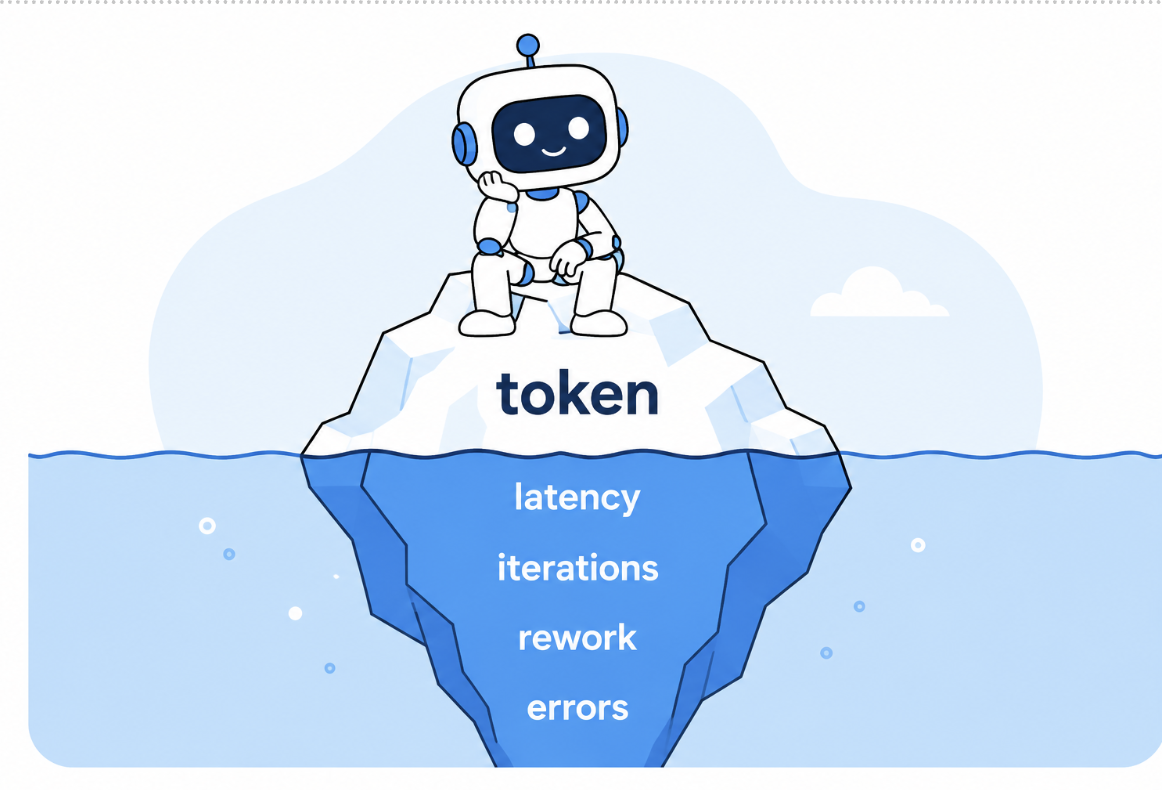
1. Look beyond token prices
The price of an AI task is more than the number shown on a model pricing page.
A more useful approximation is:
Total cost = tokens + latency + iterations + rework + cost of errors
Each part matters.
Tokens include input, output, and reasoning tokens. Higher reasoning levels can significantly increase the amount of internal work a model performs.
Latency matters because an engineer waiting several minutes for an agent to complete a simple task is also a cost.
Iterations matter because an inexpensive first attempt stops being inexpensive if the task needs to be run three more times.
Rework includes reviewing, correcting, and integrating the generated result.
And finally, errors can dominate everything else. A poor variable rename is easy to fix. A bad authorization change, data migration, or production configuration can be extremely expensive.
This is why model classes should be treated as capability tiers rather than as a simple ranking from "bad" to "good."
For the GPT-5.6 family, a useful mental model is:
- Luna for clear, repetitive, easily verifiable work
- Terra as the pragmatic default for everyday engineering tasks
- Sol for open-ended, complex, or high-risk problems
The model class determines the capability reserve available to the task. The reasoning level determines how much effort the model spends exploring, planning, and verifying its solution.
Those are two separate decisions.

2. Ask five questions before choosing a configuration
You do not need a complicated decision framework for every prompt. Five questions cover most of the important factors.
1. How open-ended is the task?
Is the path to a solution already clear, or does the model first need to determine the right approach?
Renaming a variable or implementing an established repository pattern is relatively closed. Designing a new cross-service architecture is not.
The more exploration the task requires, the more capability and reasoning reserve becomes useful.
2. How many dependencies are involved?
Is the task limited to one or a few well-scoped files, or does it span larger parts of the codebase, multiple services, databases, or external systems?
Local changes are easier to reason about. Once a task involves several moving parts, the model needs to keep more constraints and consequences in mind at the same time.
3. How expensive would a mistake be?
Would an error be caught quickly and be easy to reverse, or could it cause a production incident, data loss, a security issue, a compliance problem, or significant rework?
This question is not only about severity. Detectability and reversibility matter as well.
A mistake in generated boilerplate that is immediately rejected by the compiler is very different from a subtle authorization bug that passes the existing test suite.
4. How often will the task be executed?
Is this an occasional manual task, or part of a high-volume workflow that may run thousands or millions of times?
For a one-off architecture analysis, spending more for a stronger configuration may be irrelevant. For automated classification or code transformation at scale, small cost differences multiply quickly.
5. How well can the result be verified?
Can correctness be checked automatically with tests, static analysis, schemas, or clear acceptance criteria? Or will problems only become visible after deployment?
Strong verification allows you to experiment more aggressively with cheaper configurations because failures are easier to detect.
Together, these five questions provide a practical routing rule:
Clear + local + low-risk + high-volume + easily verifiable → less reserve
Open-ended + cross-system + high-risk + difficult to verify → more reserve
3. Compare model and reasoning level as one configuration
Comparing models by name alone is of limited value.
Think of them as capability tiers with different trade-offs. Evaluate:
model + reasoning level + cost
as a single configuration.
External benchmarks such as the Artificial Analysis Intelligence Index are useful for exploring those combinations. Each point in its comparison charts represents a particular model and reasoning level, while additional dimensions show cost, token usage, and runtime.
The interesting configurations are often those close to the Pareto frontier: points for which there is no alternative that is both more capable and cheaper.
That leads to a more useful question than "What has the highest benchmark score?"
Ask:
What is the cheapest configuration that reaches the capability level I actually need?
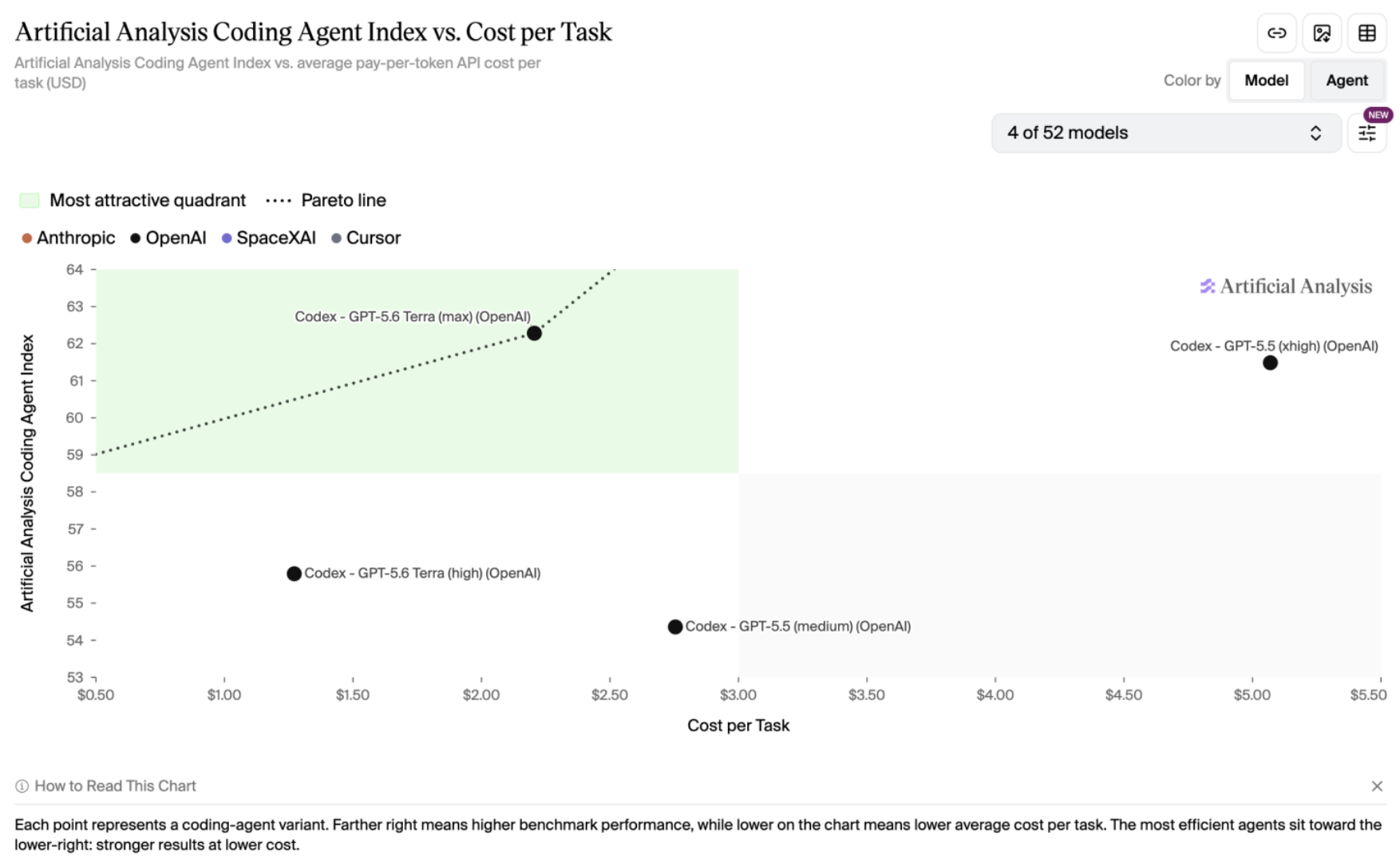
One interesting migration pattern can be seen when comparing GPT-5.5 with GPT-5.6 Terra.
Artificial Analysis shows that:
GPT-5.5 Xhigh → GPT-5.6 Terra max Artificial Analysis: 61 → 62 on the Intelligence Index. Terra is also cheaper and faster.
GPT-5.5 Medium → GPT-5.6 Terra High 55 → 56. Essentially the same benchmark range, again at a significantly lower price and with higher throughput.
This suggests a useful experiment:
If GPT-5.5 is sufficient for a workload today, test GPT-5.6 Terra with one reasoning level higher as a potentially more cost-efficient alternative.
Treat this as a test heuristic, not as a universal migration rule.
A benchmark cannot tell you whether a configuration will handle your repository, frameworks, prompts, or acceptance criteria reliably. The final comparison should always use representative internal tasks with the same starting state, context, verification, and definition of done.

4. Learn to recognize too much and too little reasoning
Once you start experimenting, the agent's behavior itself provides useful signals.
Signs that the reasoning level may be too high
You may be spending unnecessary reasoning budget when the agent:
- scans large parts of the repository for a local adjustment
- produces elaborate plans for a straightforward change
- proposes architectural improvements for an established implementation
- expands the modification beyond the requested scope
- spends significant time evaluating simple, low-risk decisions These are forms of unnecessary exploration.
The result may still be correct, but you are paying in tokens and latency for work the task did not require.
Signs that the reasoning level may be too low
The opposite pattern is usually visible as avoidable rework:
- the implementation introduces breaking changes
- important dependencies are missed
- the first solution creates additional errors
- several correction cycles are required
- tests only pass after repeated retries
In those cases, a higher reasoning budget may allow the model to plan more carefully and verify more of its assumptions before modifying the code.
But increasing the reasoning level should not always be the first response.
Before escalating, check the task setup:
- Is the task description precise?
- Did you provide the relevant context?
- Can unnecessary context be removed?
- Are the acceptance criteria explicit?
- Would separating planning from implementation help?
- Can the model run the tests or other verification tools itself?
A poorly specified task does not automatically become a good task when given more reasoning.
A practical rule of thumb
Two observations summarize the entire approach:
Too much reasoning looks like unnecessary exploration.
Too little reasoning looks like avoidable rework.
Start with a configuration that matches the apparent complexity and risk of the task. Observe how it behaves. Measure first-pass success, runtime, token consumption, retries, and human correction effort. Then adjust.
The goal is not to maximize model capability or reasoning.
The goal is to use the lowest-cost configuration that reliably produces the quality your engineering task requires.
Choosing the right AI setup is less about finding the “best” model and more about matching capability and reasoning effort to the task at hand. Start with a sensible baseline, measure the outcome, and adjust based on quality, cost, and rework. Over time, this turns model selection from guesswork into an engineering discipline.
Written by Stephan Seigewasser, Engineering Manager (Backend)